

As we open the Mortgage Bankers Associations’ 2026 Annual Conference in my hometown of Chicago,[1] my Chrisman Commentary friends reminded me that readers seem to enjoy Musings in which I complain about the Loan Originator Compensation Rule. Yet, after writing over half a dozen Musings about this brutally anti-consumer and anti-competitive Dodd Frank era regulation, those readers might wonder if I can still come up with new ways to criticize it. Yes, I’m up for this challenge. Hold my beer!
I last wrote about the LO Comp Rule about a year ago, right before the MBA’s 2025 Annual Conference. At that time, Trump’s DOGE-influenced CFPB elevated industry hopes of LO Comp reform by listing it for rescission with the Office of Management and Budget. But the CFPB seems to have lost its deregulatory mojo after taking on the “go big or go home” ECOA deregulation effort to limit use of disparate impact in assessing fair lending compliance.
With its staffing situation seemingly reaching a new homeostasis, however, CFPB is now probably just waiting for the confirmation of Brian Johnson as its new Director to get back at its deregulatory agenda. Still, despite DOGE’s chainsaw bravado imagery and considered behind the scenes industry work on reform proposals, the eminently counterproductive LO Comp Rule[2] (now over 15 years old)[3] still plagues industry and consumers alike.
Just get rid of LO Comp
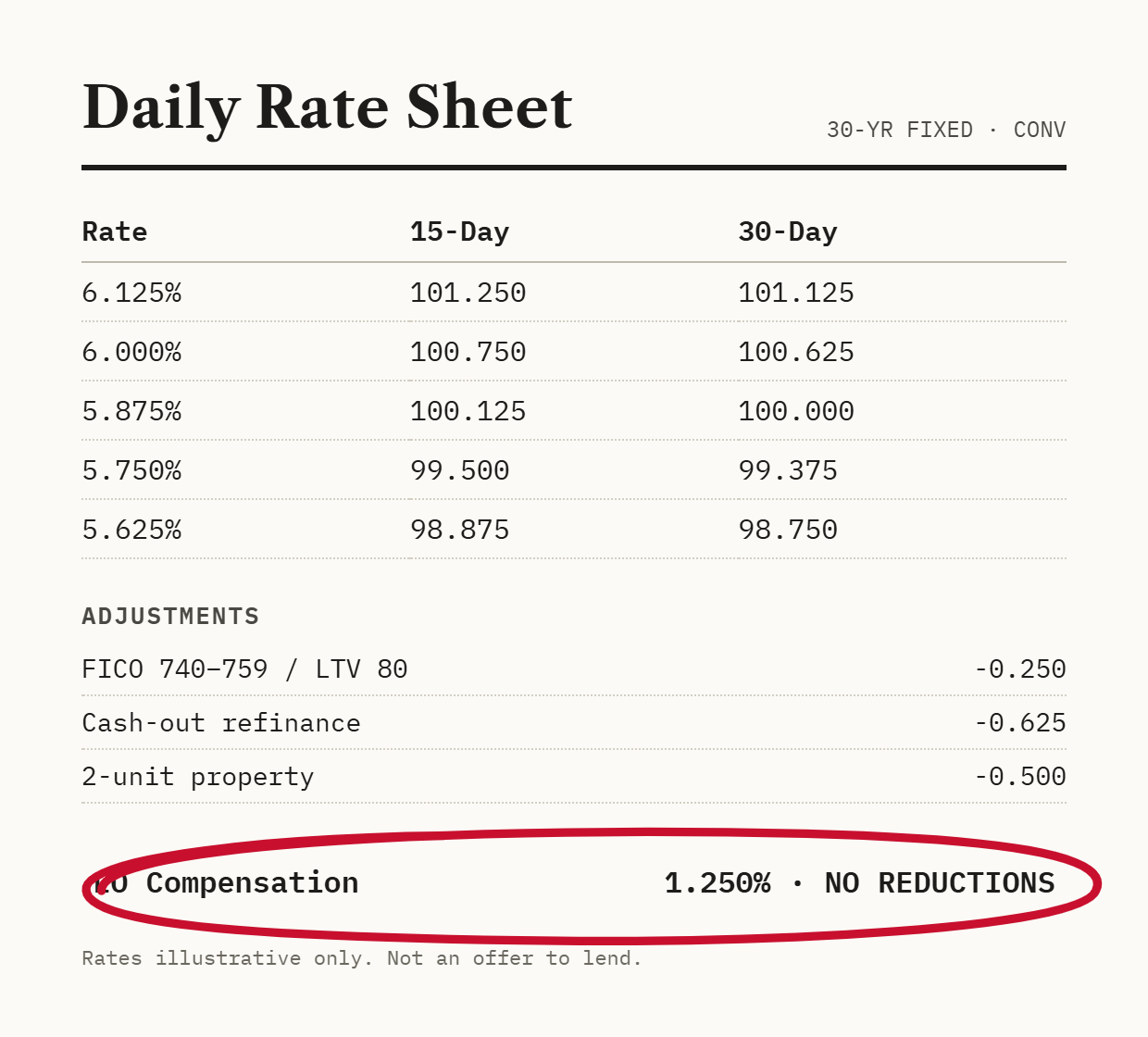
As a reminder, and paraphrasing[4] what I said in Musing #82 in which I called for the LO Comp Rule to be eliminated,[5] LO Comp is a Marxist economist’s solution to a consumer protection problem[6] that has been effectively resolved with technology and other regulations.[7] It is a price fixing regime that makes it illegal for mortgage originators to lower their own commissions. LO Comp’s premise is entirely anti-capitalist in that it assumes that the originator’s profit motive always leads to worse outcomes for consumers. Moreover, fair lending compliance management objectives to avoid illegal price discrimination don’t justify an ostensible consumer protection rule that harms all consumers by preventing discounts at the point of sale.
There’s really nothing new in that summary. I have been squawking about these same issues since 2020. So, what exactly is my “new” LO Comp beef? Well, I suggest that the LO Comp Rule, like RESPA, is in fact, a prophylactic conflict of interest rule posing as consumer protection, and through that lens it fails miserably.
Compensation corrupts?
I recently wrote about how RESPA Section 8’s anti-kickback provisions are really conflict of interest regulations. Likewise, the LO Comp Rule seeks to address another very specific asserted conflict of interest: that compensation is a corrupting influence causing loan originators to act in their own best interest instead of their customers’. So, both RESPA and the LO Comp Rule are intended to ensure that guidance provided to consumers is free from conflicting influences that could result in counsel not being in the consumer’s best interest. RESPA prohibits referral fees from causing conflicted advice in making referrals, while the LO Comp Rule seeks to prohibit originator compensation variability (tied to loan profitability) from influencing consumer advice when offering mortgage loans.
Conflicts of interest, however, are rarely black or white evidence of unacceptable corruption.[8] There are degrees of potential corruption in every conflicted relationship. Yet, unlike RESPA where Congress recognized that the Section 8 referral fee conflict issue was less concerning (i.e., less corrupting) in multiple circumstances (including for bona fide compensation),[9] the LO Comp Rule’s drafters only offered one important tolerance where they felt the conflict of interest caused by compensation tied to individual loan profitability was acceptable.[10] Specifically, they allowed commission-based compensation to increase with loan size.[11]
Lowering your own compensation is not corrupt
There is nothing corrupt (zero conflict of interest) as a consumer protection matter when originators lower prices to consumers by lowering their own commission/compensation.[12] In fact, lowering one’s own compensation is the exact opposite of acting in your own best interest at the expense of a consumer. But the LO Comp Rule’s drafters decided to prohibit originator compensation reductions out of fear that the Rule might be evaded.[13] Yet the Rule happily lets an originator earn more on a bigger loan, which is how most originators are paid today.[14]
Epic fail
Ultimately, analyzed as conflict of interest prohibition, the fact that the LO Comp Rule prevents originators from lowering their own compensation was an epic fail. While the LO Comp Rule may prevent originators from having an incentive to steer to more profitable products, it also enables steering to higher loan amounts but, nonsensically, prevents consumers from getting a better deal from commission discounts.[15]
Meanwhile, the LO Comp Rule drafters’ “evasion” concern was a terrible (baby out with the bath water) reason to prevent consumer discounts, especially when RESPA and the examination process may provide potential regulatory remedies to that concern. Specifically, RESPA Section 8(c)(2) only carves out “bona fide” compensation from its referral fee restriction. So, while not as definitive as a bright line test some might hope for, would-be evaders of an amended LO Comp Rule that permits originator compensation reductions might be risking RESPA violation(s) if they set overly high compensation rates against a bona fide standard.
There is simply no consumer protection concern with an originator who wants to lower their own commission to reduce the consumer’s price; conflict of interest or otherwise. While it’s not always in the best interest of a borrower to get a smaller loan, one can be sure that it is in the best interest of the borrower to pay less for the same loan regardless if that comes at the price of the originator’s commission.
Fair lending prophylactics
Finally, many knowledgeable LO Comp Rule aficionados have suggested that LO Comp is really a prophylactic fair lending compliance guardrail couched in an anti-steering consumer protection law. Essentially, they will say, the LO Comp Rule’s prohibition on lowering compensation is a compliance management measure to prevent overcharging minorities in violation of fair lending because originators with pricing discretion at the point of sale are likely to only offer discounts to white borrowers. The theory goes, that if originators are prohibited from lowering their price to everyone, they will not illegally discriminate.
Admittedly, allegations of race-based pricing discrimination resulted in significant fair lending settlements prior to Dodd-Frank. So, I may differ from many of my compliance management colleagues on whether this is something that the LO Comp Rule should address. While illegal discrimination should never be tolerated, I believe the LO Comp Rule is not the place to set compliance management tolerances for preventing price discrimination.
Manage fair lending yourself
Lenders concerned about fair lending compliance can (and should) place their own limit(s) on how much discretion an originator can have to lower their own compensation to improve consumer pricing, but those guardrails should not be dictated by the government to limit discounting entirely.[16] It may be a compliance challenge, but with better fair lending training and monitoring, more robust HMDA data, AI, and compliance management systems generally, compliance managers should be better equipped today to establish individualized guardrails for their own organizations.
And, to those who seek LO Comp Rule amendments, I suggest that a lender should never need a reason to provide a consumer with a discount.
More on the MBA’s Fair Lending lawsuit
Meanwhile, the meaning of “illegal discrimination” under fair lending and how that can be identified and/or proven is still an extremely contentious topic. Further to that and my last Musing about the lawsuit the Pacific Legal Foundation (PLF) filed on behalf of MBA against the state of New Jersey’s fair lending law, on Tuesday October 20, at 3:00 EST, MBA’s Vice President for Residential Policy & Managing Regulatory Counsel, Justin Wiseman and attorney Wilson Freeman of PLF will join me on the monthly Mortgage Law Today web show to discuss the MBA’s case and state of fair lending generally. It should be a fascinating discussion.
[1] I’m always happy to connect with readers at MBA Annual. Please say hello if you’ll be there!
[3] Dating back to the original Federal Reserve rule effective in 2011.
[4] I don’t think it can be considered “plagiarizing” if you are cribbing your own work, but it does seem to require at least a mention that you are repeating yourself (something which I have frequently been accused of doing).
[5] I recognize this will also take Congressional action to avoid some market damaging consequences.
[6] Specifically, LOs steering consumers to higher priced loans to obtain higher compensation for originating more profitable loans. This was a problem in the lead up to the meltdown, but whether the LO Comp Rule played any role in eliminating that issue is questionable. See Fn. #7 below.
[7] TILA’s Ability to Repay Rule ensures affordability of the loan (with a QM safe harbor limiting fees), and borrowers are empowered to shop through the internet and TRID disclosures.
[8] The normalized corruption we are seeing from the executive branch in Trump 2.0 is breathtaking and incredibly distressing to me. I fear only some future massive human tragedy will restore the proper level of outrage at public officials seeking to aggrandize themselves.
[9] See RESPA Section 8 (c)(2).
[10] The provision permitting compensation reductions for unforeseeable increases is virtually useless because it is precisely when an originator misses something they should have known that they deserve to have their compensation reduced, not when it is out of thier control.
[11] There is a direct relationship between loan size and profitability based on the market for debt. Loan size is an express exception to the LO Comp Rule’s prohibition on tying compensation to loan profitability.
[12] Spouses and dependents of mortgage originators may beg to differ.
[13] Omitted.
[14] One can easily point out how this could be somewhat harmful to consumers by encouraging overleverage and/or overpayment to home sellers, but it could also be an acceptable conflict that doesn’t raise the same kind of steering problems the LO Comp Rule was designed to prevent.
[15] This is often most harmful for consumers on loans designed to serve affordable housing initiatives (which typically are less profitable to originate) because companies are unable to pay a full commission and most originators would gladly reduce their compensation to make those deals work.
[16] Clearly the LO Comp Rule’s prohibition of compensation reduction placed far too much emphasis on fairness at the expense of consumers in general. That reminds me again of this poignant lesson about fairness delivered by Thomas Shelby from Peaky Blinders.